


 Kate McKenna, MEd, MSEd, MS, BCBA, LBA
Association for Science in Autism Treatment
The Melmark EnvisionSMART™ series of guidebooks is a set of professional manuals developed by Melmark to help human service organizations design, implement, and evaluate high-quality, evidence-based programs for individuals with autism and intellectual/developmental disabilities. This article builds on four previously published, individual reviews of the guidebooks, each of which examines one volume in greater depth. The present article takes a broader, comparative approach, examining themes, recommendations, and strategies that emerge across the series.
The series is essentially a comprehensive operations and clinical framework in book form. It translates principles from Applied Behavior Analysis (ABA) and Organizational Behavior Management (OBM) into practical systems, tools, and procedures that organizations can use in practice. The series is designed as a hands-on implementation toolkit written for administrators and organizational leaders, behavior analysts and clinicians, special educators and program staff, and human services agencies seeking system-wide improvement.
The EnvisionSMART™: A Melmark Model of Administration and Operation series is best understood as an attempt to codify the organizational logic of a large human services provider into a set of practice-oriented guidebooks. Across the volumes, the recurring premise is that high-quality services for individuals with autism, intellectual disabilities, and related support needs depend not only on sound clinical or educational interventions but also on an organizational infrastructure built through OBM. The four guidebooks consistently emphasize human service organizations (HSOs), systems design, and operational implementation. Melmark presents the series as a way of organizing the major divisions of service delivery.
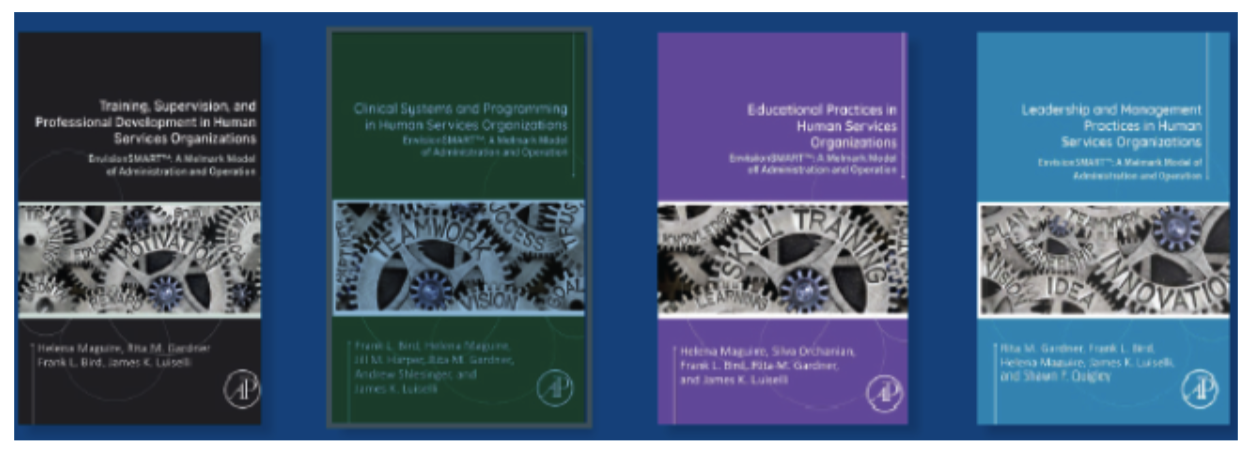
A useful way to read the series is as a progression from organizational foundation to direct service application. Training, Supervision, and Professional Development in Human Services Organizations foregrounds workforce preparation and maintenance systems. Clinical Systems and Programming in Human Services Organizations turns to assessment, behavior support, and program design. Educational Practices in Human Services Organizations applies the model to school and instructional programming. Leadership and Management Practices in Human Services Organizations expands outward to administration, operation, and program development at the executive level. Taken together, the books suggest that service quality is cumulative. Staff must be trained well, clinical systems must be coherent, educational practice must be evidence-based, and leadership must sustain the whole enterprise.
Training, Supervision, and Professional Development: The Operational Foundation
Training, Supervision, and Professional Development in Human Services Organizations functions as the workforce-development core of the series, a guide to designing, implementing, and maintaining services in HSOs through OBM. It positions staff competence as a precondition for all subsequent programmatic success. In comparative terms, this volume is less about client-facing curriculum or clinical design than about the contingencies that shape employee performance, such as onboarding, competency-building, supervision, and professional growth. Its strongest contribution is that it treats workforce development as a systems variable rather than a narrow HR concern. This volume is especially important because it guides readers to acknowledge the assumptions that clinical quality, educational fidelity, and administrative consistency all presuppose a trained workforce capable of implementing procedures reliably that the later books rely on. For a more in-depth examination of this first guidebook, readers can review ASAT’s previously published review of Training, Supervision, and Professional Development in Human Services Organizations.
Clinical Systems and Programming: Intervention Architecture
If the training volume establishes the human-performance infrastructure, Clinical Systems and Programming in Human Services Organizations provides the intervention architecture. This volume is a step-by-step plan for creating clinical programs in HSOs using Functional Behavioral Assessment (FBA) and Functional Analysis (FA), while also establishing standards and guidelines for behavior support plans that align with state and federal requirements. This makes it the most explicitly clinical and procedural of the books. Compared with the other volumes, Clinical Systems and Programming appears to be the most tightly tied to behavior-analytic assessment and treatment design. Its value lies in translating a technical clinical repertoire into organizationally reproducible systems. For readers in ABA, this is likely one of the most immediately actionable of the guidebooks because it bridges clinical rigor and operational scalability. For a more in-depth review of this second guidebook, readers may wish to consult ASAT’s previously published review of Clinical Systems and Programming in Human Services Organizations.
Educational Practices in Human Services Organizations: The School-Facing Application of the Model
Educational Practices in Human Services Organizations extends the series into the educational domain, showing how instructional programming can be built within HSOs while adhering to state and federal guidelines. This book highlights evidence-based instructional methodologies, including discrete trial training, errorless learning, and incidental teaching, which signals that the volume translates the EnvisionSMART model into classroom and school-program design. Educational Practices is less centered on assessment-driven behavior support systems and more focused on instructional delivery, curriculum implementation, and educational compliance. In comparison with the training volume, it shifts attention from staff competence in general to the specific educational environments in which those competencies are enacted. Its major contribution is to resist treating education as separate from the rest of a human services organization. Instead, it frames schooling as one subsystem within a larger administrative and clinical ecology. That systems perspective is a major strength, particularly for organizations serving students with intensive support needs across educational, residential, and therapeutic contexts. For a deeper dive into this third guidebook, please refer to ASAT’s previously published review of Educational Practices in Human Services Organizations.
Leadership and Management Practices: The Executive Synthesis
Leadership and Management Practices in Human Services Organizations serves as the executive synthesis of the series. This fourth and final guidebook in the EnvisionSMART series focuses on administration, operation, and program development in HSOs for persons with intellectual and developmental disabilities and explicitly notes that the model is formed from ABA and OBM. This book moves above the level of discrete service domains and addresses governance, administration, and organizational stewardship. Compared with the first three volumes, Leadership and Management Practices offers the broadest institutional lens. Where the training book addresses the workforce, the clinical book addresses treatment systems, and the educational book addresses instructional programming, the leadership volume lays out how all those divisions are coordinated, resourced, and sustained. In comparative reading, this makes it the most integrative volume conceptually. Its significance lies in making explicit what the other books imply: that no practice model survives without administrative contingencies, performance accountability, and program development capacity. For a review of this fourth and final guidebook, readers can refer to Leadership and Management Practices in Human Services Organizations.
Themes Across the Series
One of the clearest themes across all of the volumes is the conviction that organizational infrastructure is inseparable from service quality. Rather than presenting effective human services as the product of isolated expert practitioners, the series argues for coordinated systems: trained staff, standardized procedures, compliant programming, instructional fidelity, and administrative oversight. This is what gives the series its coherence and distinguishes it from handbooks that may treat clinical, educational, and leadership topics independently.
A second shared theme is the centrality of ABA/OBM as the conceptual “grammar” of the series. The books are founded on organizational behavior management, behavior support systems, and evidence-based instructional methods associated with behavior analysis. For readers aligned with ABA-based human services, this consistency is a major strength because it creates conceptual continuity from staff training to executive administration. For readers outside that orientation, however, the series may seem ideologically consolidated around one dominant framework.
A third shared theme is replicability. The series does not give readers abstract or conceptual theory. The model in the guidebooks is derived from Melmark’s organizational practice and is intended to help HSOs design and maintain effective systems. That applied emphasis makes the books especially useful to administrators, program directors, behavior analysts in leadership, and graduate students preparing for systems-level roles. Each guidebook addresses the question of transferability, demonstrating how organizations with different funding streams, staff competencies, cultures, and regulatory environments can adopt the EnvisionSMART approach.
Summary
As a series, EnvisionSMART™ is an integrated blueprint for human services administration. The books complement one another effectively: the training volume builds staff capacity, the clinical volume structures intervention systems, the educational volume translates those systems into instructional contexts, and the leadership volume organizes the enterprise at the managerial level. This internal coherence is the series’ greatest strength. For practitioners and scholars interested in how a large HSO operationalizes quality through systems design, the EnvisionSMART books offer a valuable body of applied organizational literature.
References
Bird, F. L., Maguire, H., Harper, J. M., Gardner, R. M., Shlesinger, A., & Luiselli, J. K. (2023). Clinical systems and programming in human services organizations: EnvisionSMART™: A Melmark model of administration and operation. Academic Press.
Gardner, R. M., Bird, F. L., Maguire, H., Quigley, S. P., & Luiselli, J. K. (2025). Leadership and management practices in human services organizations: EnvisionSMART™: A Melmark model of administration and operation. Academic Press.
Maguire, H., Gardner, R. M., Bird, F. L., & Luiselli, J. K. (2022). Training, supervision, and professional development in human services organizations: EnvisionSMART™: A Melmark model of administration and operation. Academic Press.
Maguire, H., Orchanian, S., Bird, F. L., Gardner, R. M., & Luiselli, J. K. (2023). Educational practices in human services organizations: EnvisionSMART™: A Melmark model of administration and operation. Elsevier.
McKenna, K. (2025). Elevating the delivery of human services with EnvisionSMART: A Melmark model of administration and operation. Science in Autism Treatment, 22(9).
Reference for this article:
McKenna, K. (2026). A comparative review of Melmark’s EnvisionSMART™ guidebooks. Science in Autism Treatment, 23(12).
Prior Reviews of this Series
- Book Review: EnvisionSMART: A Melmark model of administration and operation
- Book Review: Training, supervision, and professional development in human services organizations: EnvisionSMART™
- Book Review: Clinical systems and programming in human service organizations: EnvisionSMART™
- Book Review: Leadership and management practices in human service organizations: EnvisionSMART™
- Book Review: Educational practices in human service organizations: EnvisionSMART™
